Startups
Dec 20, 2025
How a Swedish startup became the fastest-growing SaaS company in history and what every founder can learn from their playbook
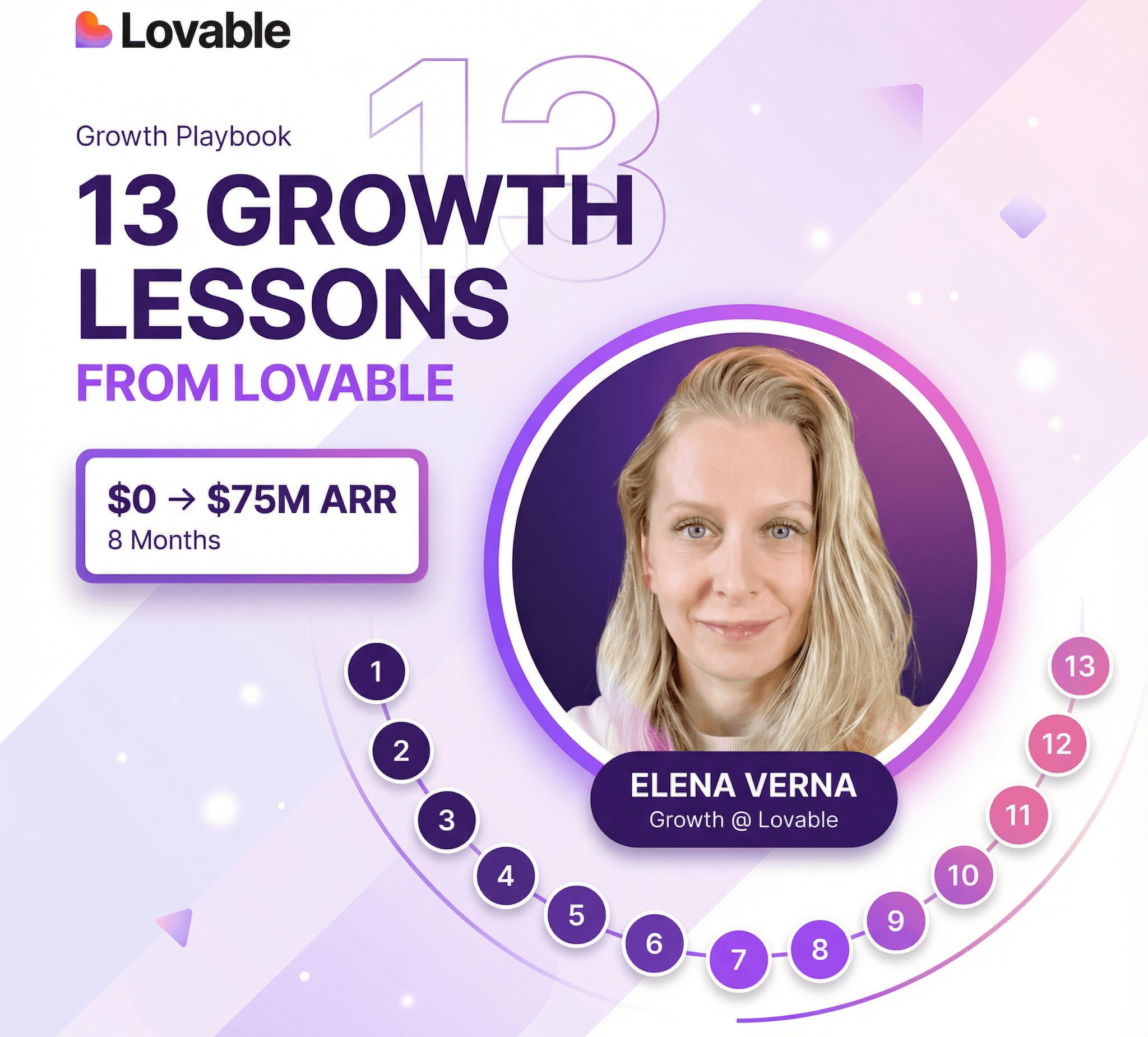
In January 2024, most people had never heard of Lovable. By September 2024, they had reached $75 million in annual recurring revenue with just 45 employees. That's not a typo. That's the fastest growth trajectory in SaaS history.
We've studied their journey obsessively. Not because we want to copy them, but because their story contains lessons that apply to every product competing for attention in a crowded market. At Rectify, watching Lovable's rise has directly shaped how we think about growth, community, and what it means to build something people genuinely want.
This isn't another surface-level case study. We're breaking down 13 specific, actionable lessons from Lovable's growth playbook that any product can implement starting today.
Lesson 1: Build Your Audience Before Your Product
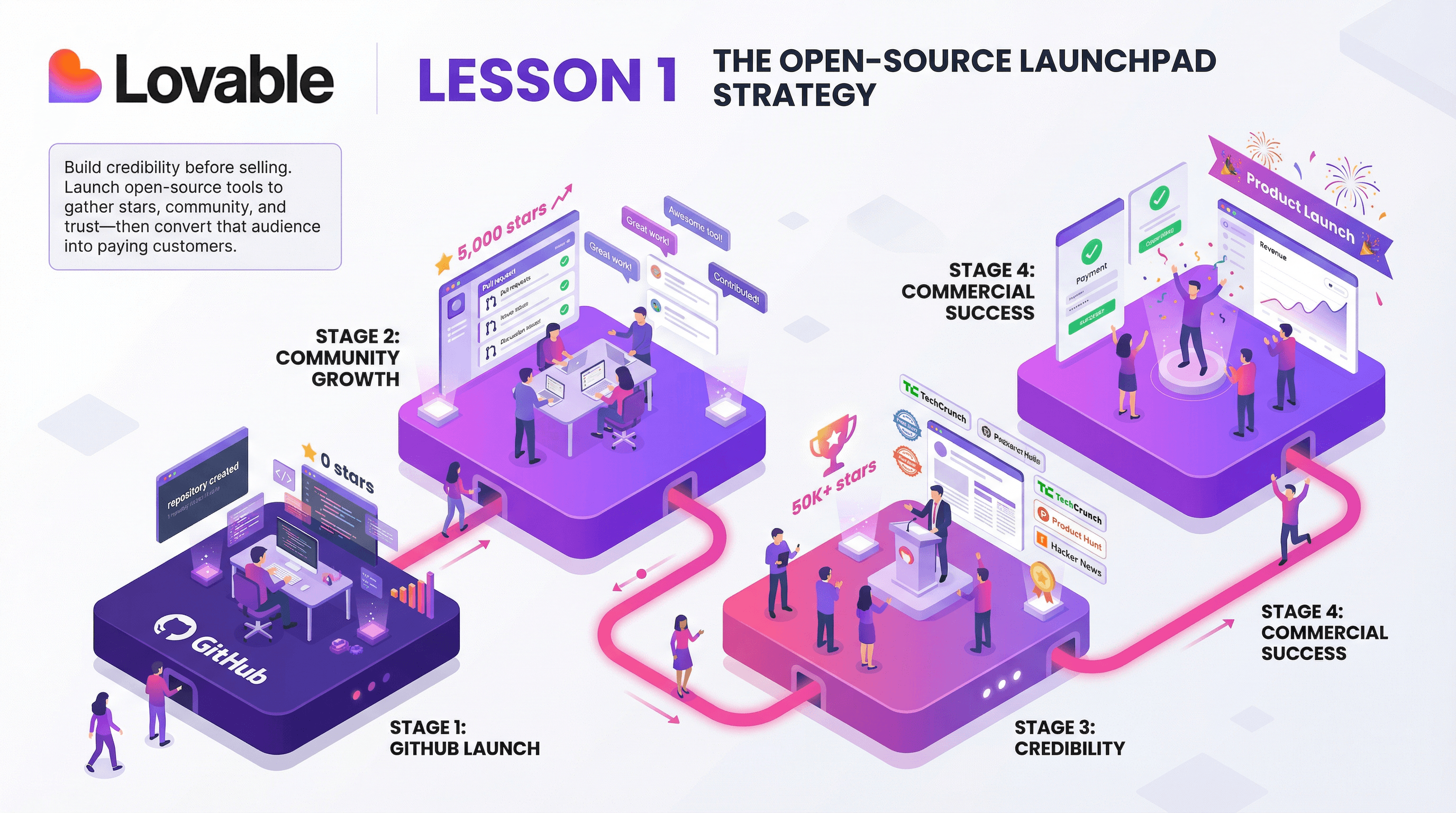
Before Lovable existed, there was GPT-Engineer. Anton Osika, Lovable's founder, released it as an open-source project on GitHub in mid-2023. It gathered over 50,000 stars and became one of the most popular AI coding repositories on the platform.
Think about what this meant when Lovable launched. They didn't need to explain who they were or build credibility from scratch. Tens of thousands of developers already knew Anton's work, trusted his approach, and were waiting to see what came next.
The traditional playbook says: build product, then find audience. Lovable flipped this entirely. They found their audience first through genuine contribution to the community, then channeled that attention into a commercial product.
How to apply this
You don't need to open-source your entire product. But you can extract valuable components and release them for free. Create tools, templates, or resources that solve real problems for your target audience. Build reputation through genuine value before asking for anything in return.
The key insight: your free work isn't marketing expense. It's trust-building infrastructure that compounds over time.
Lesson 2: Launch Multiple Times With Different Angles
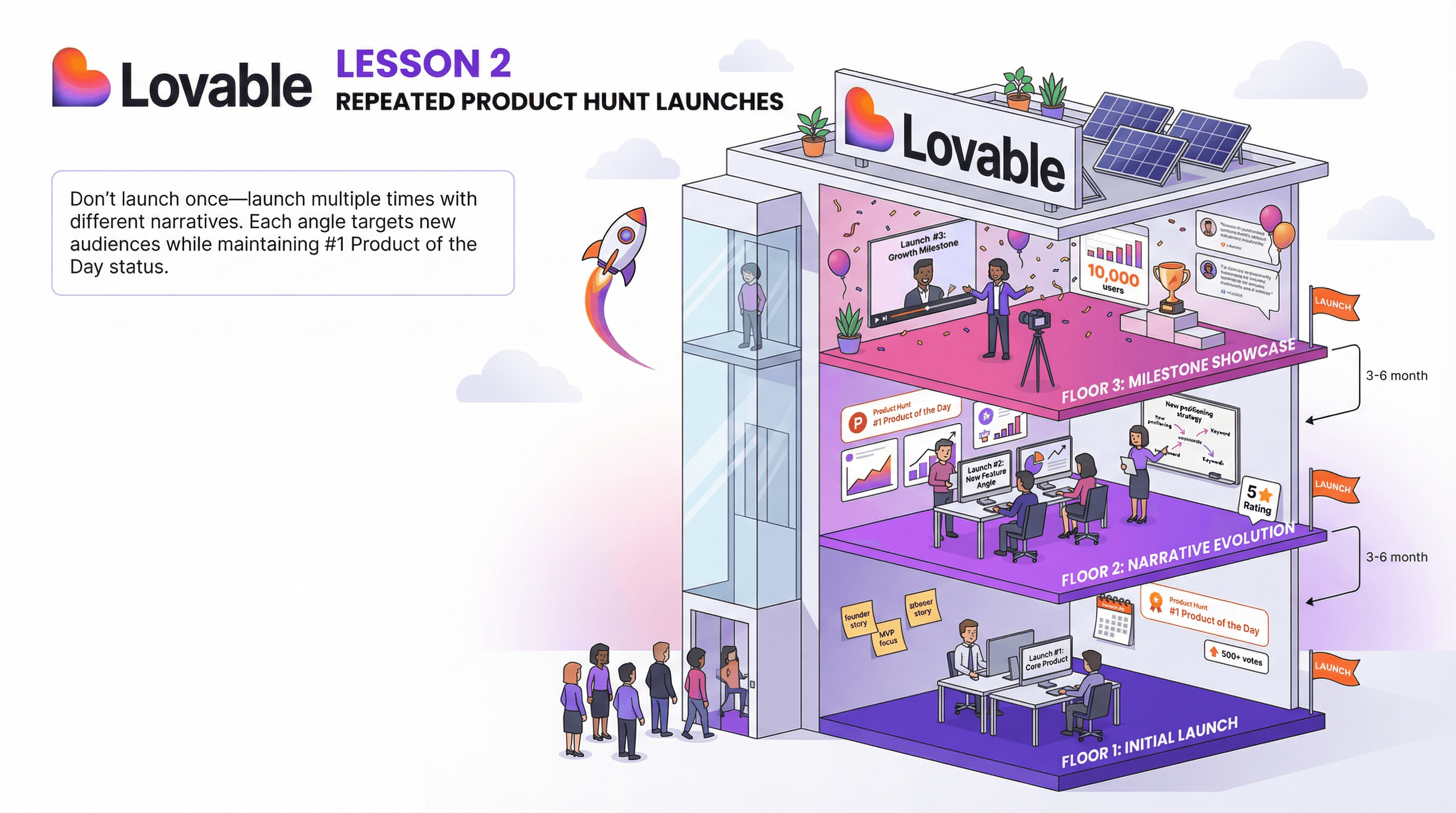
Most founders treat Product Hunt as a one-shot opportunity. Launch day comes, you hold your breath, and whatever happens, happens. Lovable approached it completely differently.
Anton launched on Product Hunt multiple times. First as GPT-Engineer in January 2024, then multiple times as Lovable evolved. Each launch targeted a different angle and audience segment. Their most successful launch achieved #1 Product of the Day with a perfect 5-star rating.
The insight here is profound: every major update, every new capability, every significant milestone is a valid reason to re-launch. You're not spamming. You're giving the community legitimate new reasons to pay attention.
How to apply this
Plan a launch calendar, not a launch day. Map out 3-4 Product Hunt moments throughout the year. Each launch should tell a slightly different story: one focused on a new feature, another on a milestone, another on a specific use case. Build a launch squad of engaged users who will show up for each one.
Lesson 3: Make Founder Content Your Primary Marketing Channel
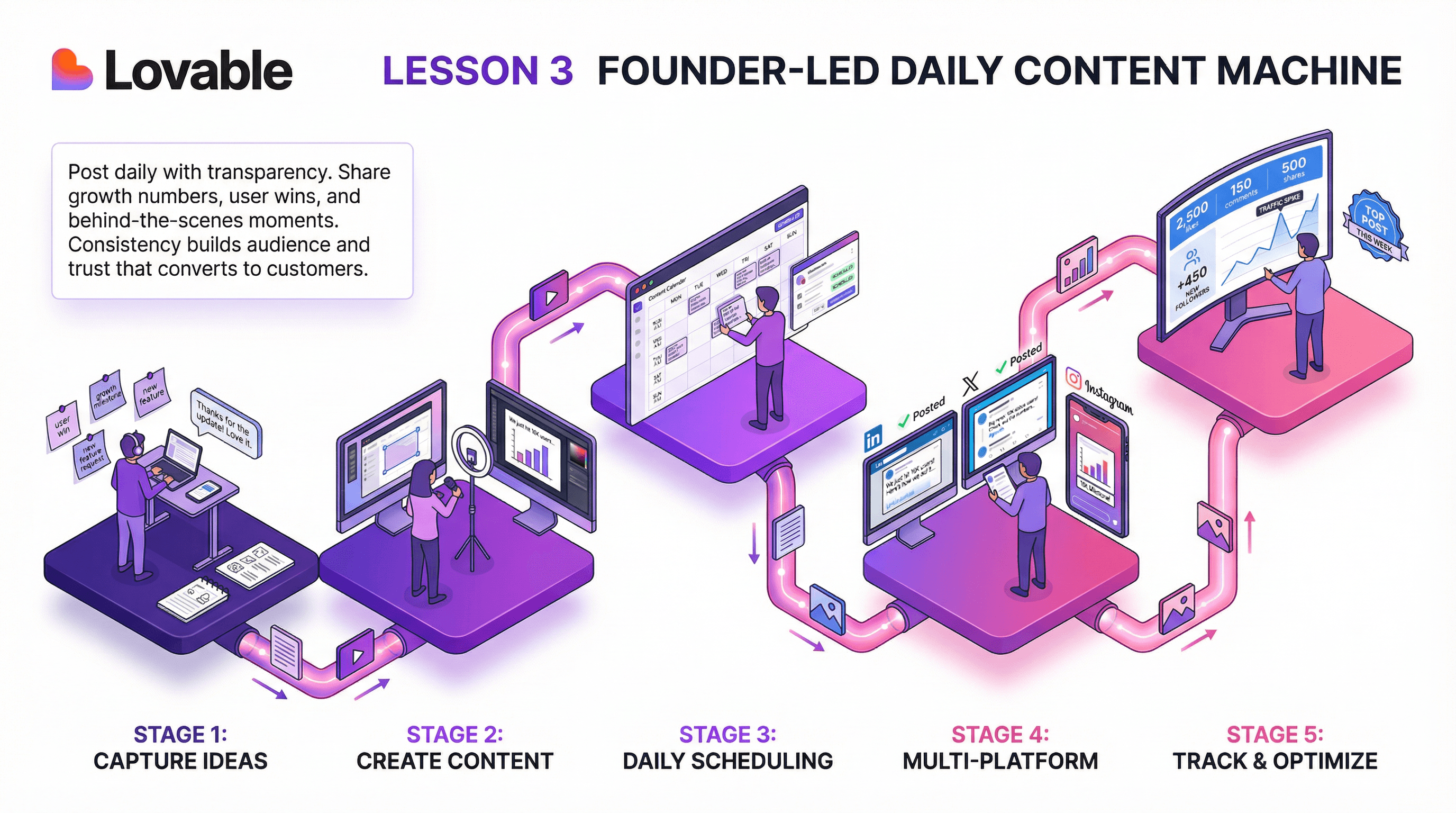
Anton Osika posts daily on X/Twitter. Not occasional updates. Daily. He shares product updates, growth milestones, user wins, behind-the-scenes content, and genuine reflections on building in public.
This isn't about vanity metrics or personal brand building for its own sake. It's about the fundamental truth that people connect with people, not logos. When a founder shares the journey openly, including the struggles and uncertainties, it creates a bond that no amount of traditional marketing can replicate.
Anton's posts consistently emphasize the "minimum lovable product" philosophy. He shares real numbers transparently. He celebrates user wins as if they were his own. This authenticity is impossible to fake and impossible to compete against with paid advertising.
How to apply this
Pick one platform and commit to daily presence. It doesn't have to be long-form content. A quick observation, a screenshot of something you shipped, a lesson learned that day. The consistency matters more than polish. Your audience wants to follow the journey, not consume perfected content.
Lesson 4: Turn Your Users Into Your Marketing Department
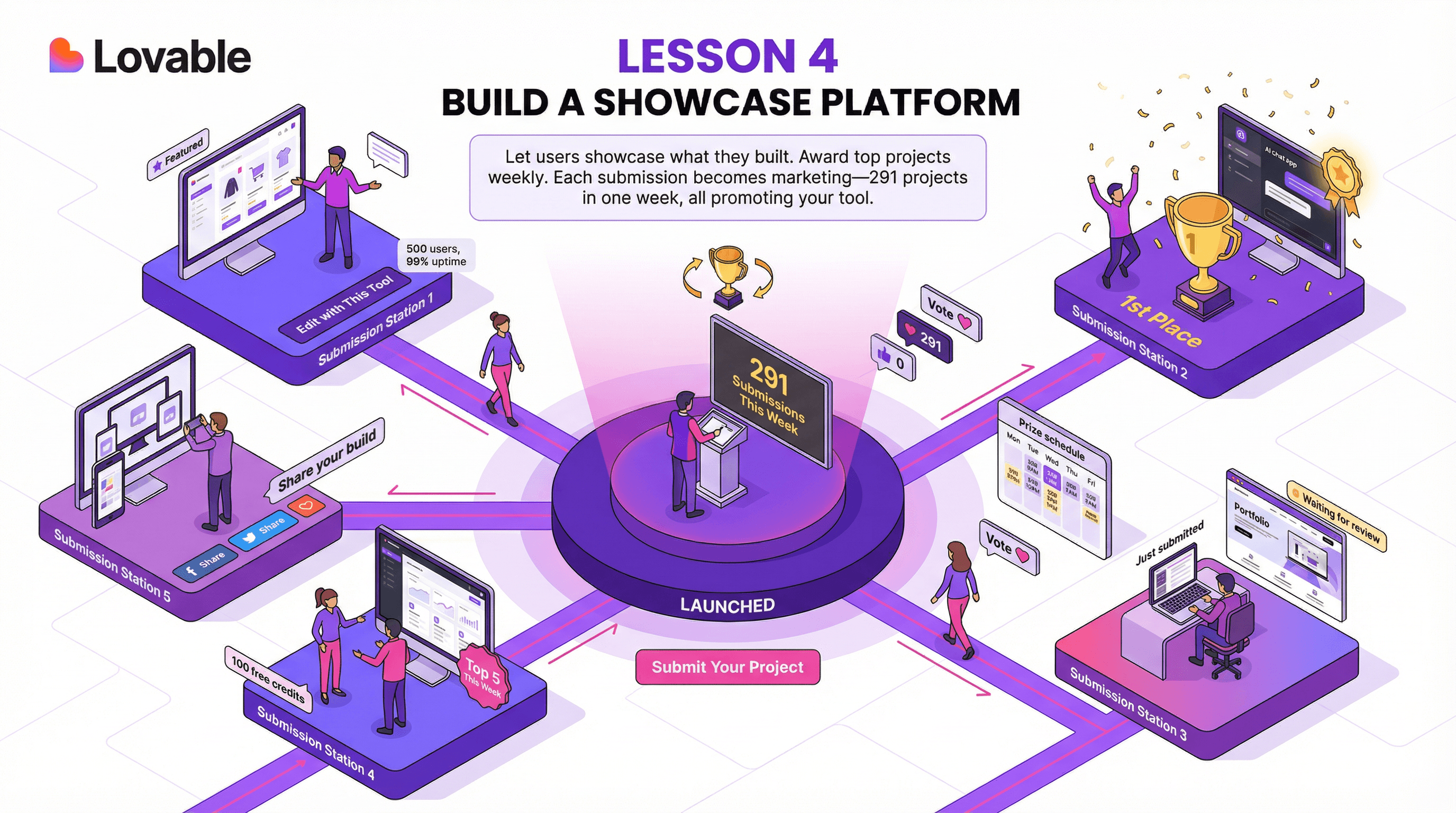
Lovable created launched.lovable.dev, essentially a mini-Product Hunt where users submit apps they built with the platform. The top 5 projects each week win 100 free credits. Simple mechanics, massive results.
In a single week, they received 291 submissions. Each submission is a user publicly declaring "I built this with Lovable." Each showcase page includes an "Edit with Lovable" button. Every user success story becomes marketing content that Lovable never had to create.
The genius is in the incentive alignment. Users want recognition for their work. Lovable wants social proof and distribution. The showcase platform satisfies both simultaneously.
How to apply this
Create a dedicated space to highlight what users build or achieve with your product. It doesn't need to be complex. A simple gallery with submission forms and weekly highlights can drive significant engagement. Add incentives that feel generous but cost little: free months, feature highlights, social amplification.
The underlying principle: every customer success is potential marketing material. Build systems to surface and celebrate those successes publicly.
Lesson 5: Partnerships Are Distribution, Not Features
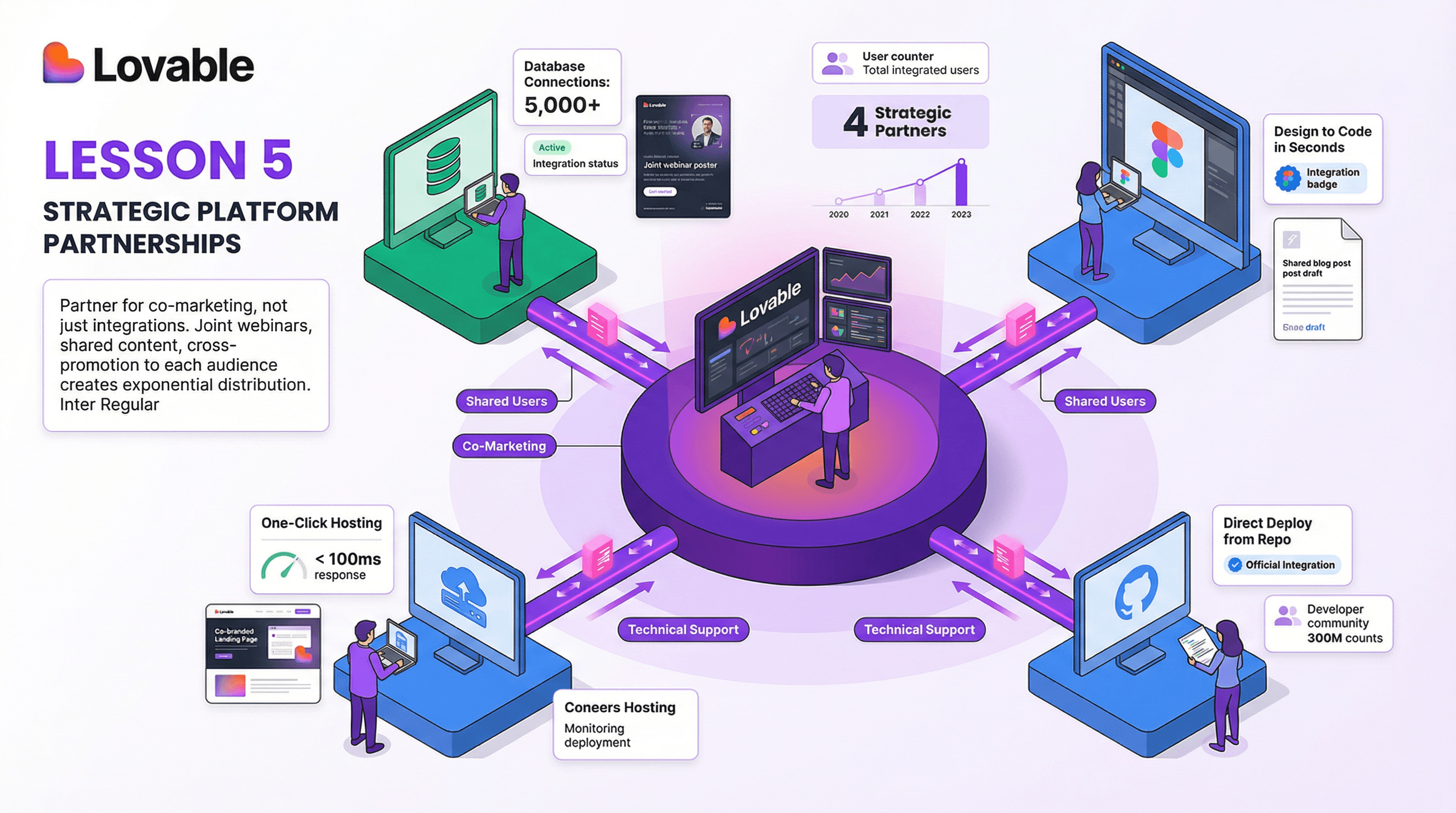
Lovable partnered with Supabase, Figma, and GitHub early on. But these weren't just integration announcements buried in release notes. Each partnership became a co-marketing opportunity with joint videos, blog posts, and cross-promotion to each partner's audience.
When Lovable announced their Supabase integration, it wasn't "we now support Supabase." It was a coordinated campaign where both companies promoted the integration to their respective audiences. Lovable gained access to Supabase's developer community. Supabase showed their users a compelling new way to use their platform.
This is a fundamentally different way to think about integrations. Most companies treat partnerships as product features. Lovable treats them as distribution channels.
How to apply this
Identify the tools your target users already rely on. Approach those companies not just with "we want to integrate" but with "we want to create something valuable together that serves both our audiences." Prepare co-marketing assets: joint landing pages, case studies, webinars, social campaigns.
The integration is table stakes. The distribution opportunity is the real prize.
Lesson 6: Build Viral Tools That Cost Almost Nothing
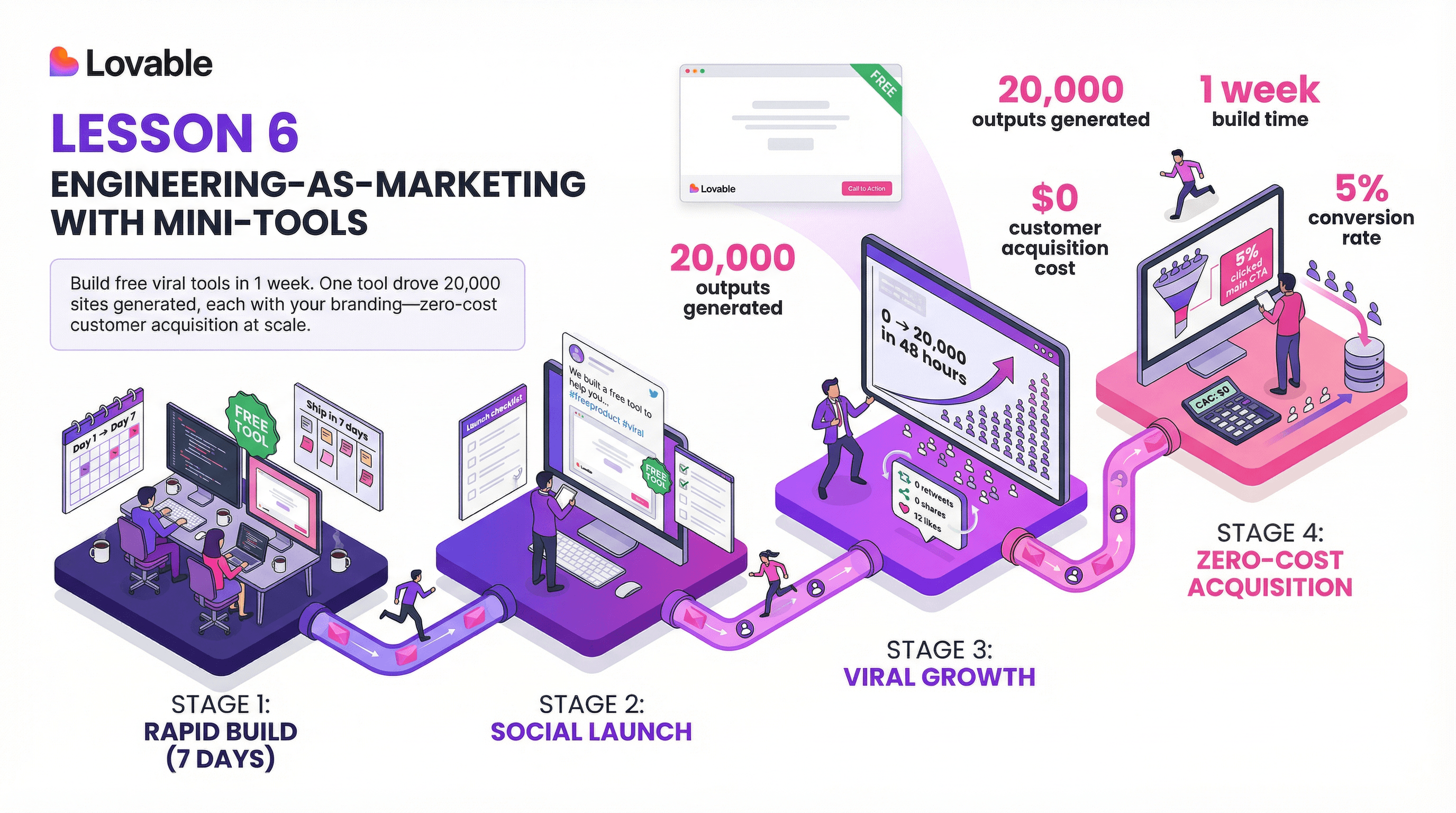
Lovable built "Linkable" in about a week. It's a free tool that converts your LinkedIn profile into a personal website. A single tweet about it drove over 20,000 websites generated. Each website includes a subtle "Edit with Lovable" prompt.
The math here is staggering. One week of engineering time generated 20,000+ touchpoints with potential users. Compare that to the cost of acquiring 20,000 website visitors through paid advertising. The ROI isn't even comparable.
These mini-tools serve a specific purpose: they solve a narrow problem well enough that people want to share them. They demonstrate the underlying technology without requiring commitment. And they create natural pathways to the core product.
How to apply this
Identify adjacent problems your target users face. Build quick, focused tools that solve those problems in a sharable way. The tool should deliver value in under 60 seconds, include natural virality (share buttons, embeddable results), and create a clear path to your main product.
Engineering-as-marketing sounds like a buzzword until you see the numbers. Then it just looks like math.
Lesson 7: Community Is Your Moat, Not Your Feature List
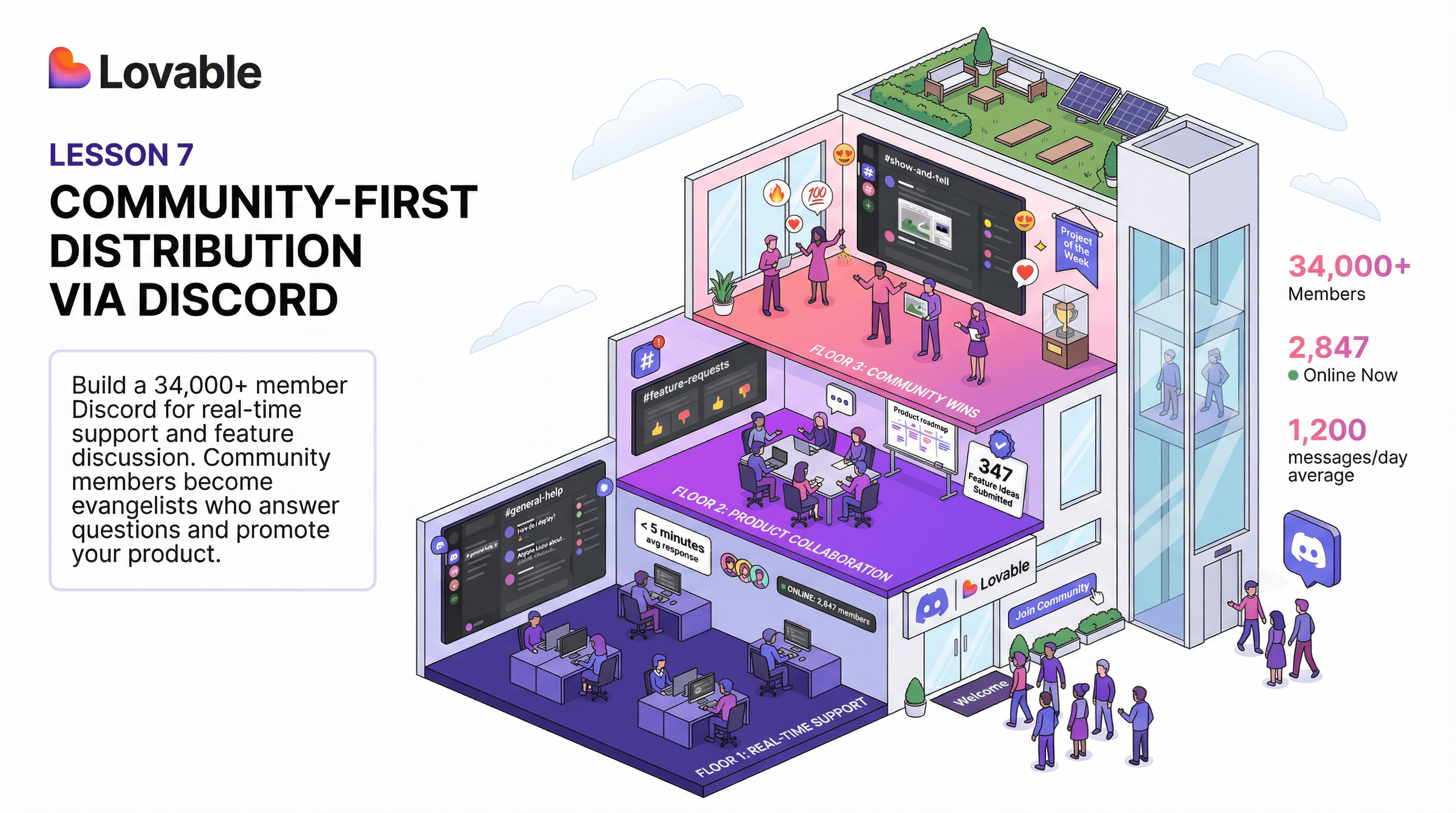
Lovable's Discord community has grown to over 34,000 members. But the number isn't what matters. What matters is what happens inside that community every day.
Users help other users. They answer questions before the team can respond. They share what they've built and celebrate each other's wins. They provide feature feedback and bug reports in real-time. They become evangelists who promote the tool to their networks organically.
A competitor can copy your features. They can match your pricing. They can even hire your employees. But they cannot replicate a thriving community built over months and years of genuine engagement. The community becomes defensible in a way that technology alone never can be.
How to apply this
Start your community before you think you're ready. Focus on the broader identity, not just your product. Lovable's community isn't about "Lovable users." It's about people building things with AI. Create spaces for users to help each other, not just talk to you.
The most valuable community activities are peer-to-peer: users answering questions, sharing templates, collaborating on ideas. Your job is to create the container and set the culture. Then get out of the way.
Lesson 8: Reddit Is an Underrated Goldmine
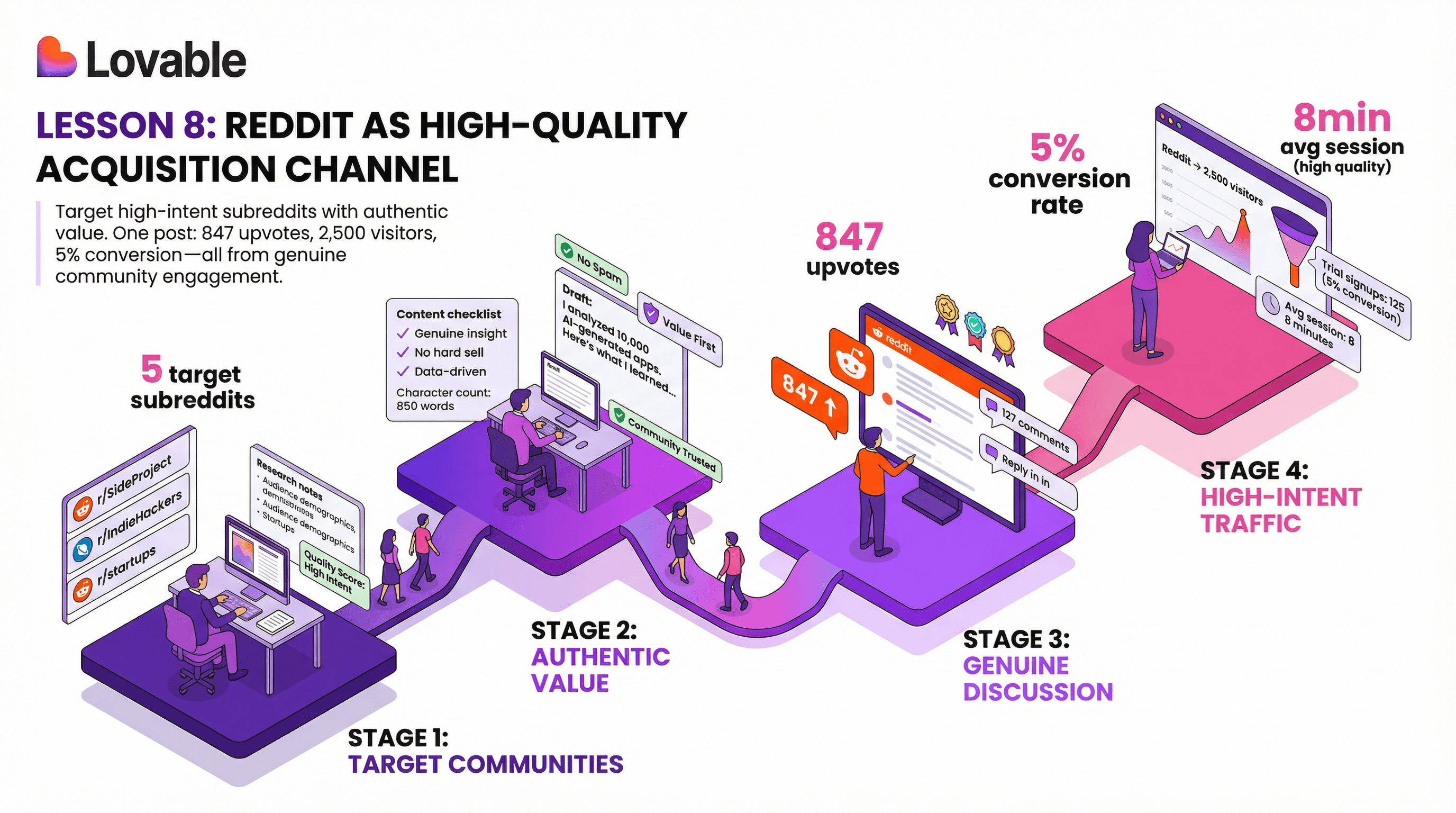
Search Reddit for Lovable discussions and you'll find something interesting. Threads with titles like "I built 30 apps in 30 days with AI tools" that happen to mention Lovable as the standout. Not promotional posts. Genuine experience shares that include the product naturally.
Reddit traffic is some of the highest-quality traffic on the internet because users are actively seeking solutions. They're in problem-solving mode, not passive scrolling mode. When someone finds your product through a Reddit recommendation, they arrive with built-in trust because the recommendation came from a real person in a real conversation.
The catch: Reddit has the most sensitive BS detector of any platform. Promotional content gets downvoted into oblivion. Authentic contributions get amplified. There's no shortcut.
How to apply this
Identify the subreddits where your target users already spend time. Commit to being genuinely helpful there for weeks before ever mentioning your product. Share lessons, answer questions, contribute value. When you do mention your product, it should feel natural and contextual, never promotional.
The 90/10 rule works here: 90% pure value contribution, 10% product mentions when genuinely relevant.
Lesson 9: Treat Podcasts Like a Tour
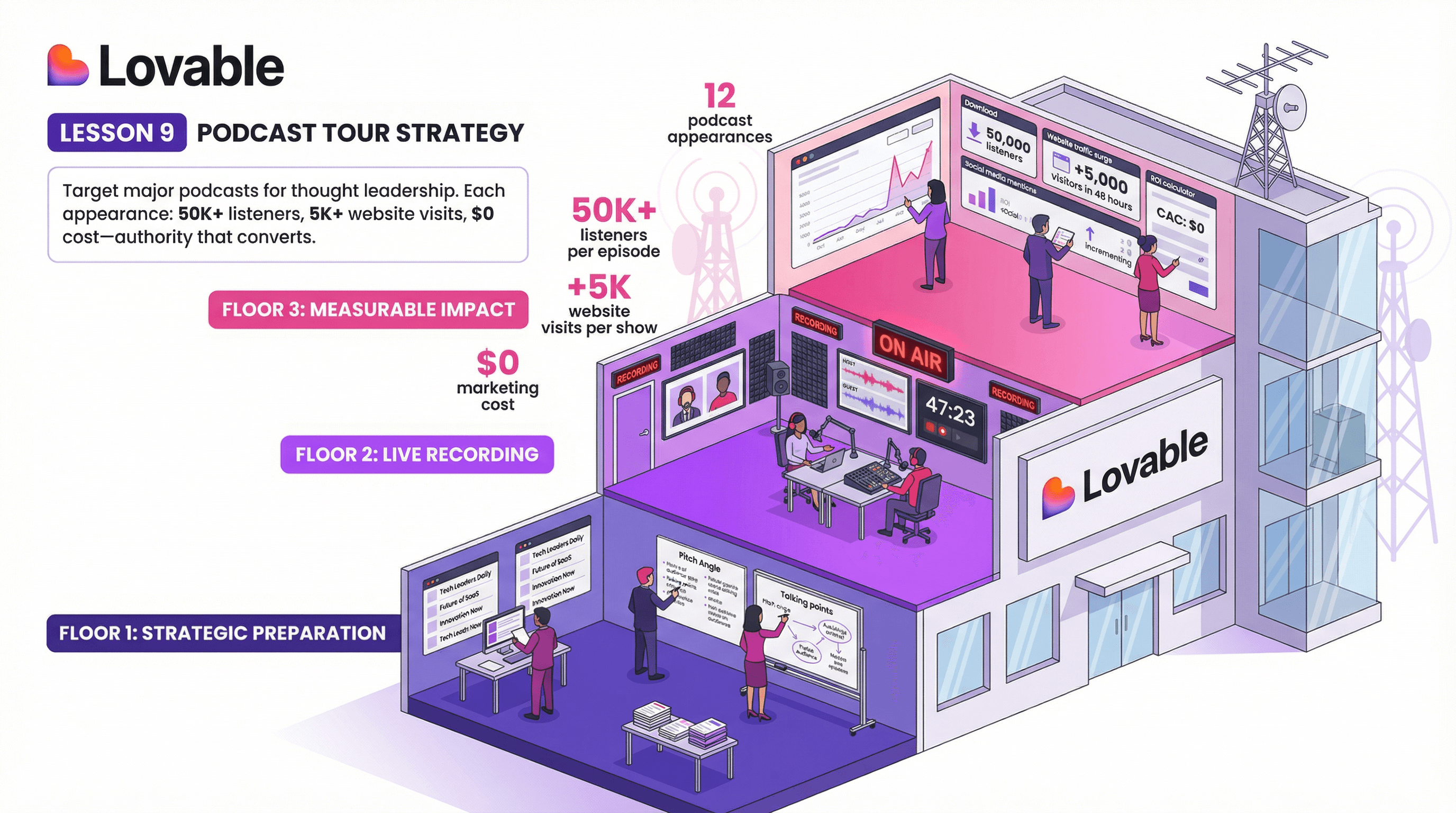
Anton appeared on what feels like every major tech podcast in existence. Lenny's Podcast. 20VC with Harry Stebbings. The Cognitive Revolution. This Week in Startups. The list goes on.
Each appearance served multiple purposes. Direct traffic from listeners. SEO value from backlinks and transcripts. Credibility from association with respected shows. Content that can be repurposed into clips, quotes, and social posts.
But the deeper value is narrative control. When Anton appears on a podcast, he gets to tell the Lovable story in his own words, unfiltered, for 45-90 minutes. No character limits. No algorithm interference. Just direct access to an engaged audience.
How to apply this
Build a target list of podcasts your ideal customers listen to. Start with smaller shows to practice your story and build a portfolio. Develop 2-3 distinct angles you can pitch: a controversial take, a unique insight from your data, a personal journey story.
The pitch template that works: "We've seen [specific surprising data point] from our [X thousand] users. I can share what this reveals about [broader trend] and what founders are missing." Hosts want interesting guests, not product pitches.
Lesson 10: Eliminate Every Second Before the "Aha" Moment
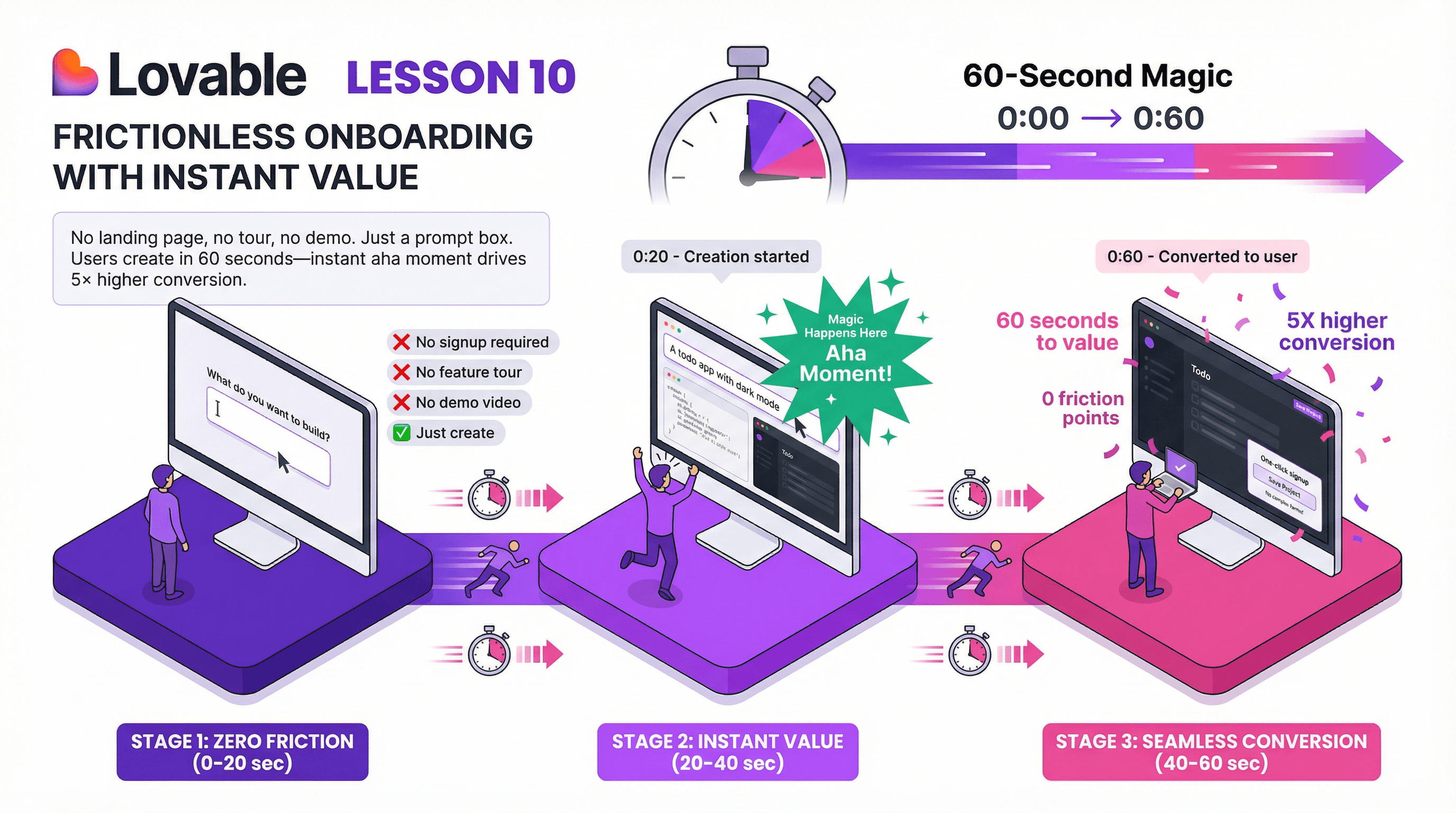
Visit Lovable's website and you won't see a traditional landing page. No feature lists. No pricing comparisons. No "schedule a demo" buttons. Instead, you see a blank prompt box. Type what you want to build. Hit enter. Watch it happen.
The entire experience is designed around one principle: minimize the time between arrival and magic moment. Every second of friction, every additional click, every form field is an opportunity for someone to leave.
Most products bury the value behind signup forms, onboarding flows, and configuration steps. Lovable puts the value first. Sign up later, if you want. But first, experience why you would want to.
How to apply this
Map your current user journey from landing page to "aha" moment. Count every click, every form field, every decision point. Now ask: which of these can be eliminated entirely? Which can happen after the user experiences value instead of before?
The goal is 60 seconds or less to real value. Not promised value. Not explained value. Experienced value.
Lesson 11: Build in Public to Create FOMO Loops
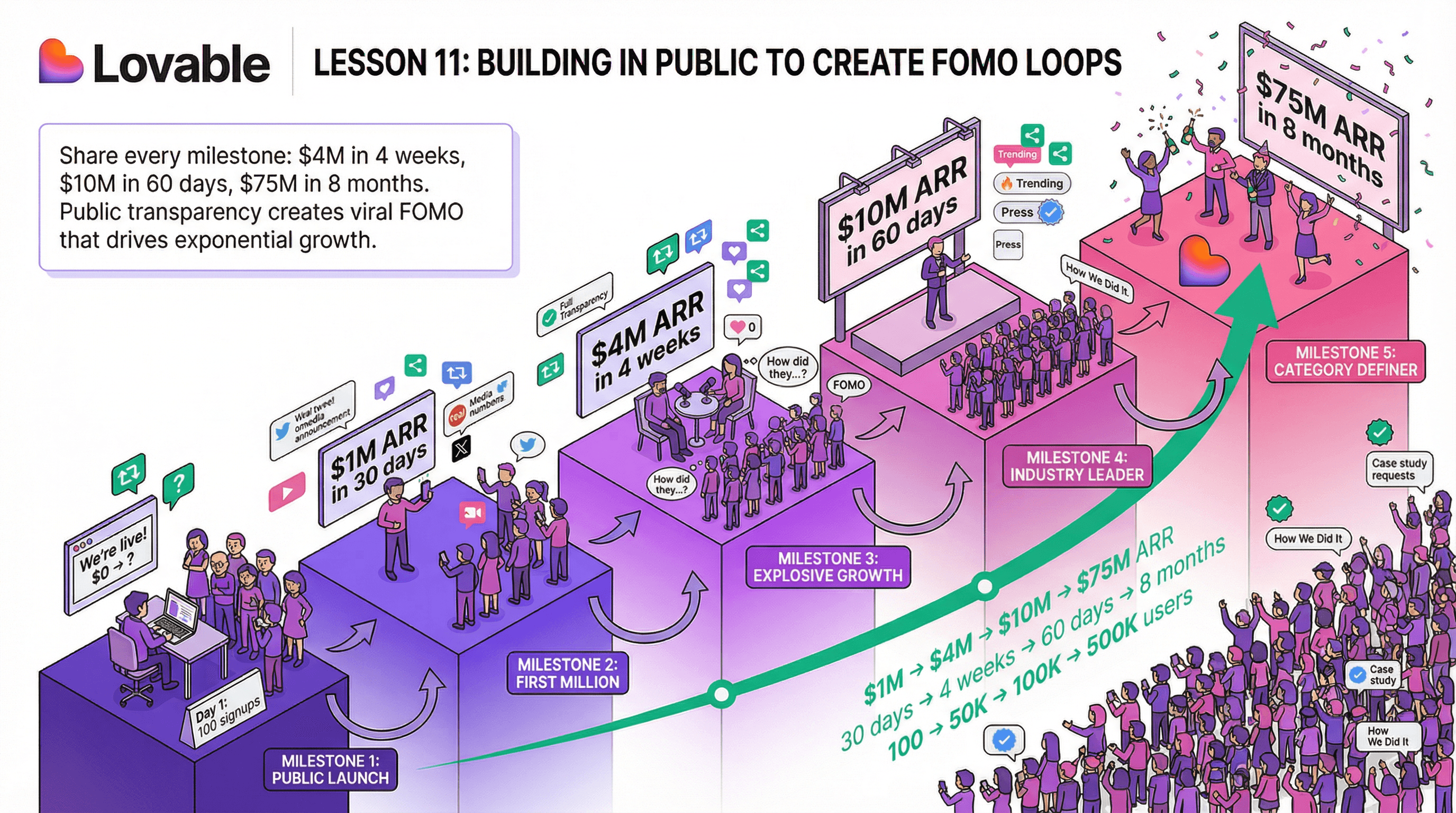
$4 million ARR in 4 weeks. $10 million in 60 days. $30 million. $50 million. $75 million. Each milestone, publicly shared. Each number, another reason for people to pay attention.
This transparency creates a specific psychological effect: fear of missing out on something real. When you see a company growing this fast and being this open about it, you want to understand why. You want to be part of whatever is happening.
Building in public isn't about ego or vanity metrics. It's about creating ongoing reasons for people to pay attention. Every milestone is content. Every challenge overcome is a story. Every success is social proof.
How to apply this
Share your numbers. Not just revenue, but users helped, problems solved, bugs fixed, features shipped. Create a milestone content calendar. Plan how you'll announce each threshold before you reach it.
The narrative should be the journey, not just the destination. People want to follow along and feel like they're witnessing something building momentum.
Lesson 12: Make Price a Competitive Weapon
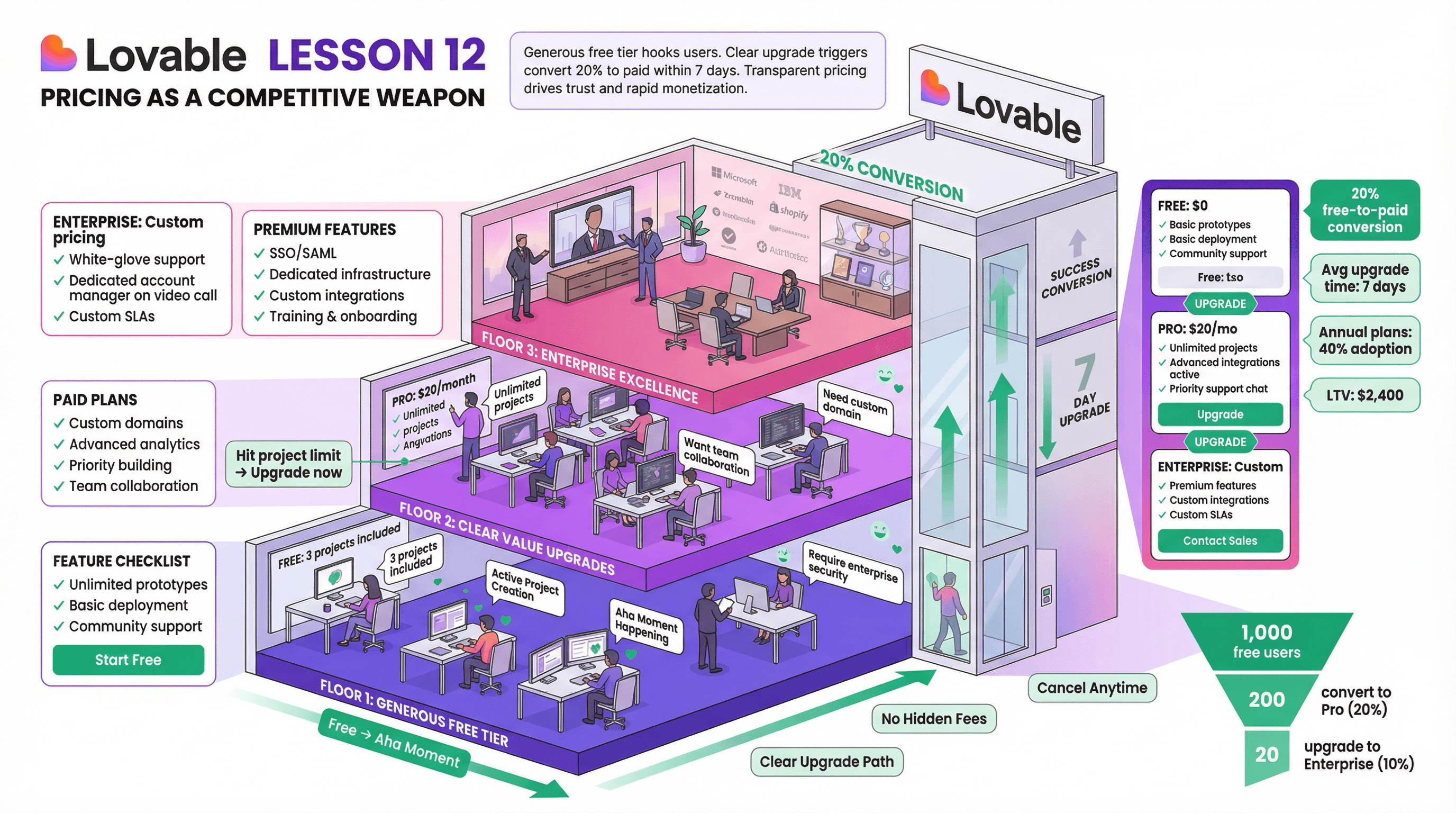
Lovable's freemium model isn't just about lowering barriers. It's about creating rapid activation. Users experience the product's full potential on the free tier. The upgrade happens because they want more of something they've already proven valuable, not because they're gambling on potential.
This creates a fundamentally different conversion dynamic. Traditional freemium limits functionality to force upgrades. Lovable's approach limits quantity while maintaining quality. You can build real things on the free tier. You just might want to build more of them.
Pricing becomes a growth lever when it's designed for activation rather than extraction. Every free user who experiences the magic is a potential advocate, even if they never pay.
How to apply this
Audit your free tier against one question: can users experience genuine value before paying? Not teaser value. Not limited value. Real, memorable, shareable value. If the answer is no, you're optimizing for conversion at the expense of activation.
Consider what "generous but not unlimited" looks like for your product. Enough to experience the magic. Not enough to never need to upgrade.
Lesson 13: Hire Generalists Who Move at Startup Speed
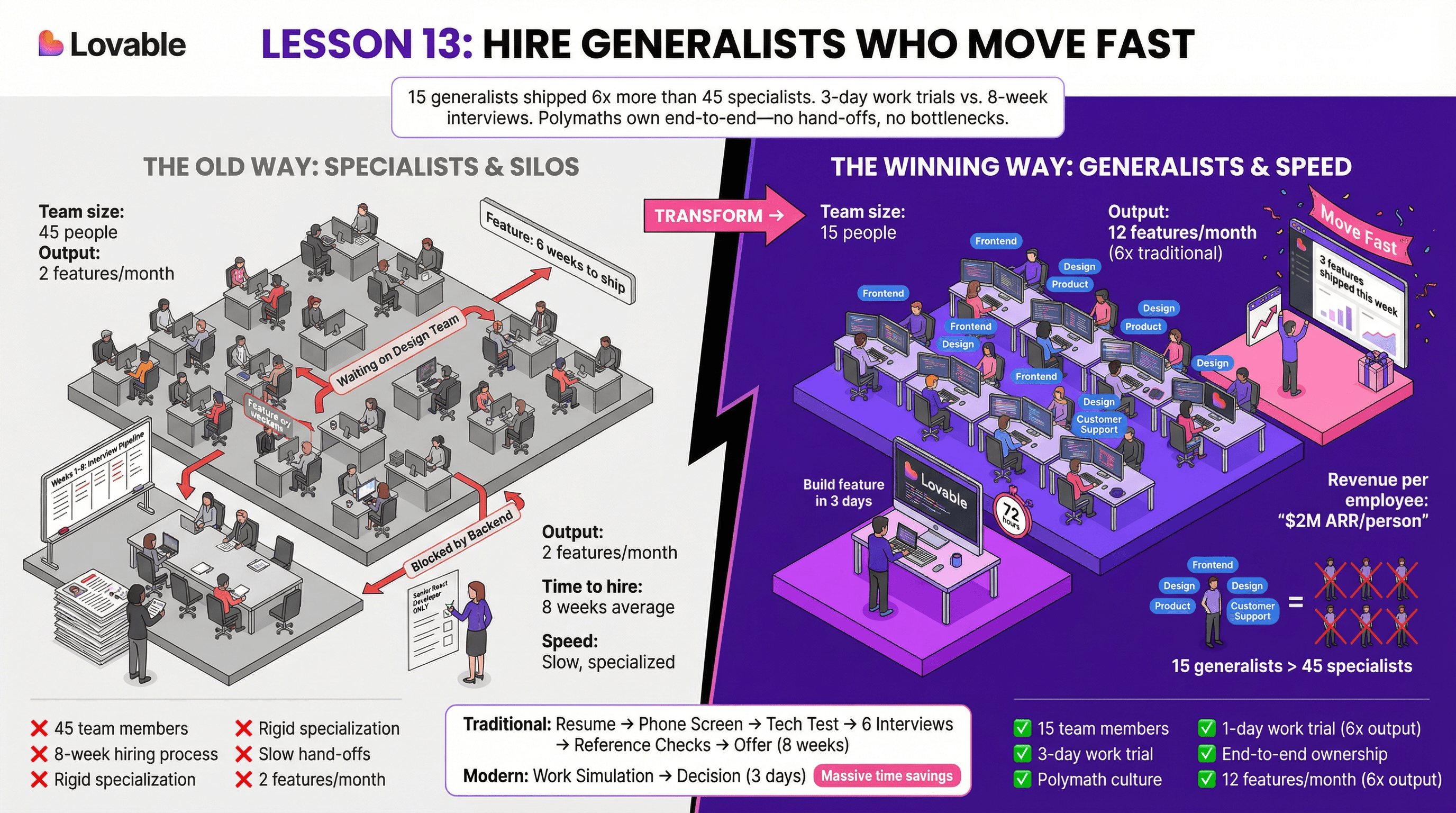
$75 million ARR. 45 employees. Do the math: that's over $1.6 million in ARR per employee. For context, most successful SaaS companies target $200-400K per employee.
Lovable achieved this by hiring what they call "polymaths." People who can handle architecture, design decisions, product judgment, and communication. Not specialists who excel in one narrow area. Generalists who can own entire problems end-to-end.
Their hiring process reflects this: work simulations instead of traditional interviews. Give candidates a real problem. Watch how they solve it over 1-7 days. The work reveals what interviews hide.
How to apply this
For small teams especially: prioritize ownership over specialization. Someone who can take a feature from concept to shipped to marketed is more valuable than three specialists who need to hand off work.
Use work trials. Design a realistic project that takes a few days. Pay for their time. Judge based on output, not credentials. The people who produce under realistic conditions will produce after you hire them.
What This Means for Your Product
Lovable's growth isn't about one brilliant strategy. It's about the compounding effect of doing many things well, simultaneously, for an extended period.
Community plus content plus partnerships plus product-led growth plus build-in-public creates something that no single channel can match. Each element reinforces the others. The community creates content. The content drives partnerships. The partnerships provide distribution. The distribution feeds the community.
At Rectify, watching Lovable's journey has been both inspiring and instructive. We serve a related audience: the people who build with tools like Lovable, Cursor, and Bolt, and then need help running what they've built. Lovable showed us what's possible when you genuinely serve your community instead of just selling to them.
The lesson that sticks with us most: distribution beats technology. Lovable didn't win by having the best AI. They won by putting that AI in front of the right people, in the right way, repeatedly.
"Our competition isn't other AI tools. It's user awareness."
That insight applies to every product. Your competition probably isn't other products in your category. It's the gap between what you offer and who knows about it.
Close that gap, and the growth follows.
Building something with AI tools? Rectify is the operations platform that helps you run what you've built. Session replay, uptime monitoring, support inbox, and much more in one place.